
How Many Days a Week Should You Work Out? Building a Routine That Fits
Sunday evening is a wonderful time to design an ambitious workout routine. Monday gets a strength session. Tuesday gets a class. Wednesday gets a run. By Thursday, the calendar looks like it belongs to someone with fewer meetings and a much shorter commute. Then the week begins. The question of how many days a week you should work out often gets answered with a number before anyone asks what those days contain. Two carefully planned sessions and regular walking can mean something very different from two rushed visits spent deciding what to do.
For many adults, two or three strength sessions are a practical starting point, with aerobic activity accumulated throughout the week. More training days can help with particular goals, but they are not a requirement for making progress. The useful schedule is one that gives your body enough work, enough recovery and a reasonable chance of seeing you again next week.

Start with the weekly activity target
The World Health Organization’s physical activity guidelines recommend 150–300 minutes of moderate aerobic activity, or 75–150 minutes of vigorous activity, each week for adults. An equivalent combination works too. They also recommend strengthening all major muscle groups on at least two days a week. Those are weekly activity targets. They do not mean you need to visit a gym five times.
A brisk walk to work can contribute to your aerobic total. So can cycling, swimming or a class that sustains an appropriate intensity. Strength training addresses another part of the recommendation; do not automatically count every minute spent lifting as aerobic activity. If you currently do very little, these targets can be a direction to build towards. The guidelines explicitly recognise benefits below the recommended amount and advise increasing activity gradually.
Beginning with two manageable appointments is more useful than postponing exercise until a five-day routine becomes possible.
Two strength sessions can produce meaningful progress
One revealing trial compared schedules that looked quite different on a calendar. In a 12-week study of 50 women new to resistance training, one group completed two full-body sessions each week. Another trained four times, dividing the work between upper- and lower-body sessions. Both groups performed the same exercises and weekly number of sets and repetitions.
Both improved, with no significant differences between the groups in strength or muscle mass. Four visits did not produce a clear advantage over two when the weekly work was matched.
This was one study in previously untrained women, not proof that every two-day programme equals every four-day programme. It does offer reassurance that a modest schedule can be productive.
The 2026 American College of Sports Medicine position stand likewise recommends resistance training with sufficient effort at least twice weekly, involving all major muscle groups.
For a beginner, that might mean a leg press or squat, a hip hinge, a push and a pull, with the exercises and workload adapted to experience.

What a third or fourth day actually changes
An extra session gives you more opportunities to practise and somewhere to put additional training. It can also make individual workouts shorter.
Imagine a programme containing six weekly sets of a particular exercise. You could distribute them as three sets on two days or two sets on three days. The frequency changes; the number of sets does not.
Research does not support treating frequency as irrelevant, though. A 2026 analysis of training volume and frequency, drawing on 67 studies, found that higher frequency was associated with greater strength gains, with diminishing returns. The relationship with muscle growth was much less clear.
The analysis was predominantly based on younger adults, mostly men, and its models do not identify one perfect schedule for everyone.
If you want to improve a particular lift, another opportunity to practise it may help. If your existing sessions already feel rushed or exhausting, spreading the work out may be useful. Neither requires turning every additional visit into another maximal-effort workout.

Muscle growth depends on more than the calendar
For building muscle, the amount of challenging work you complete deserves attention alongside how often you train.
A meta-analysis of training frequency and muscle growth found no meaningful advantage to higher frequency when weekly training volume was matched. Higher frequency can still help you organise more work, but the extra calendar entry is not itself a muscle-building stimulus.
The same principle appears in a 2024 review comparing split and full-body routines. Across 14 studies, researchers found similar improvements in strength and muscle growth when training volume was equated.
A full-body routine trains the major muscle groups in each session. A split distributes them across different sessions. Neither format automatically makes a programme more advanced or more effective.
Choose the arrangement that lets you complete useful work with attention and control.
Give each workout a clear job
Before adding days, decide what you want those days to achieve. Getting stronger, preparing for a race and enjoying a varied fitness routine call for different priorities.
These examples are starting structures, rather than prescriptions tested against one another:
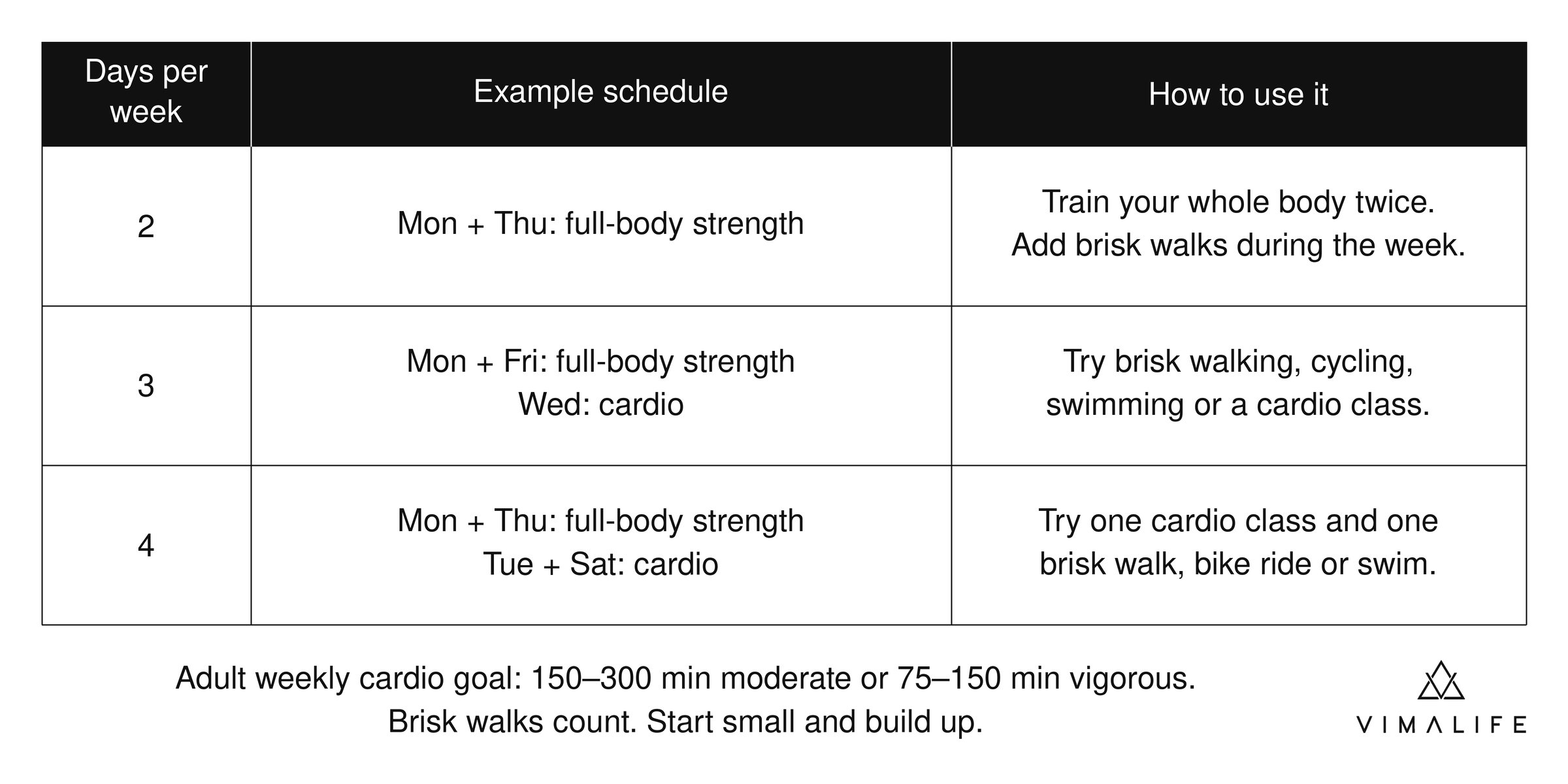
The four-day option has more strength sessions; the three-day option makes room for a dedicated cardio visit. They serve different preferences rather than forming a ranking from least to most successful.
An experienced runner might arrange things differently again, placing key runs first and fitting strength around them.
Cardio can fit between gym visits
Aerobic activity does not need to wait for a clear hour in your day. For example, five brisk 20-minute walks add up to 100 minutes. Add a 50-minute bike ride at a moderate effort and you reach 150 minutes without five separate gym appointments. Shorter walks can also contribute; you do not have to collect all your activity in long sessions. This arithmetic is an example, not a starting requirement. Someone returning after a long break may need shorter outings before that amount feels comfortable.
Consider the parts of the week that already involve getting somewhere. A walk before the train, a lunchtime loop or a journey completed by bike can make activity easier to accommodate. Keep the intensity in mind, too. A gentle stroll and a demanding spin class can both be worthwhile, but they do not represent the same training load or contribute identically to the aerobic target.

What if the weekend is your main opportunity?
The research offers some flexibility here as well. A large study of more than 350,000 adults compared people who concentrated their activity into one or two sessions with those who spread it across more sessions. Among people meeting activity recommendations, mortality rates did not differ significantly after accounting for the total amount of activity.
That finding concerns long-term health associations. Activity was self-reported, and an observational study cannot prove that the schedules were equally effective for fitness, muscle growth or injury prevention. It does suggest that a busy weekday schedule need not make exercise pointless.
Build weekend activity gradually. Going from little movement to two punishing sessions is a different proposition from an established routine built around Saturday and Sunday.
Leave room to recover and adjust
Counting workout days tells you surprisingly little about how demanding a week has been. A relaxed yoga class, heavy leg session and long run place different demands on you. When starting full-body strength training, leaving a day between sessions is a straightforward way to arrange recovery. Gentle movement can still fit between them. More experienced lifters may train on consecutive days while distributing the work across different muscle groups.
Look at patterns over several sessions. Are you repeatedly losing repetitions, struggling to maintain technique or arriving unusually tired? Review the workload, sleep and food intake before adding another day. Soreness alone is a poor attendance planner. Feeling sore does not establish that a workout was effective, and being comfortable does not automatically mean you need to train harder.

Build a version for the busy week
A routine becomes more useful when it includes a fallback. If your usual plan is three sessions, decide which two you will protect when work gets busy. If one visit is all you can manage, complete an appropriate session and return to the regular schedule when you can. A large review of resistance-training prescriptions found that all the programmes examined improved strength and muscle growth compared with no exercise. The details influenced outcomes, but useful training was possible through several approaches.
Start with the week you have. At VIMALIFE in Leslieville, gym access, classes and coaching offer different ways to put that week together. A routine that leaves you making steady progress is worth keeping, even if someone else’s calendar contains more workouts.