
Kettlebell Training for Functional Strength: 6 Exercises to Try
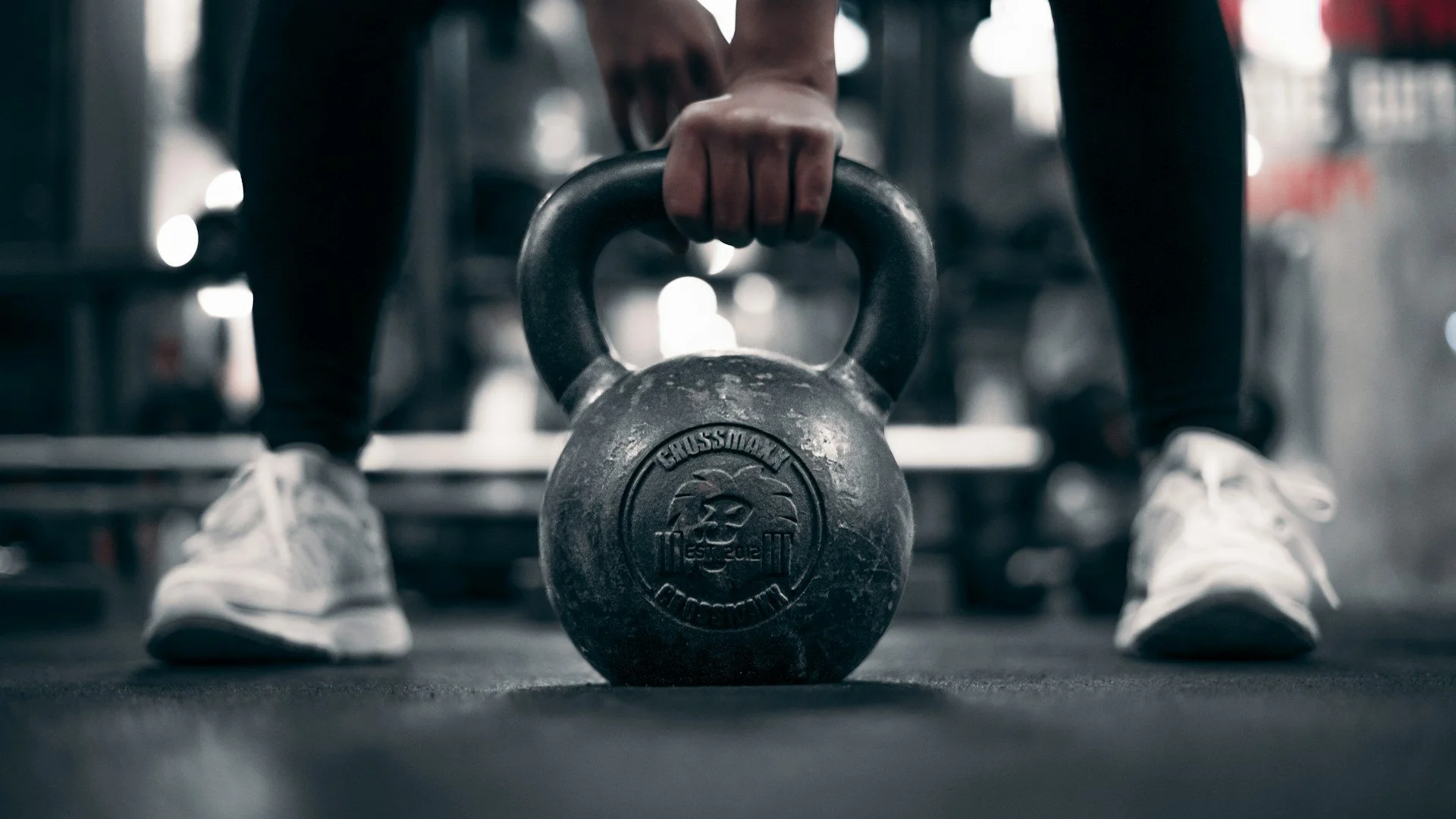
Kettlebells are easy to overlook. They usually sit somewhere between the dumbbells and the functional training area, looking like heavy little cannonballs with handles. If nobody has ever shown you what to do with one, you might pick one up, attempt a few squats and quietly return it to the rack.
That would be understandable. It would also be a shame. One kettlebell can train your legs, glutes, back, shoulders, grip and core. You can lift it slowly to build strength, swing it to develop power, carry it to challenge your stability or use it in a circuit that gets your heart rate up surprisingly quickly. It can be the focus of an entire full-body workout or simply make an exercise you already know feel completely different. That versatility is what makes kettlebell training so useful, and why the kettlebell might be one of the most underrated pieces of equipment in the gym.
Why Does a Kettlebell Feel Different From a Dumbbell?
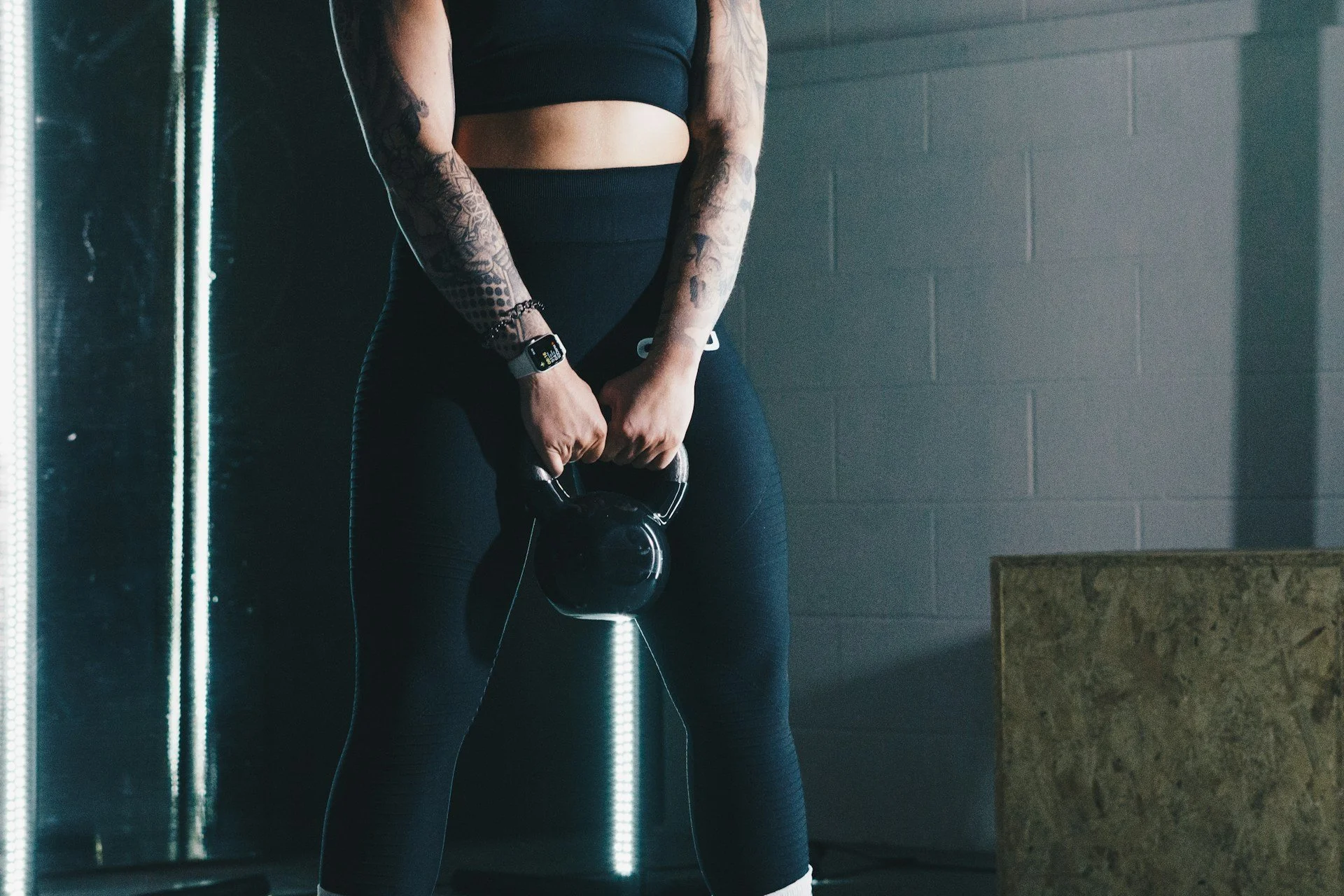
A 20-pound kettlebell does not feel the same as a 20-pound dumbbell. With a dumbbell, the weight is balanced on either side of your hand. With a kettlebell, most of the weight sits below the handle. This changes how the load pulls on your body and how much work it takes to control it. You can feel the difference during something as simple as a suitcase carry. Pick up one kettlebell, hold it beside your body and start walking.
Within a few steps, you will notice that your core has to stop you from leaning toward the weight. Your grip has to remain strong. Your shoulder needs to stay controlled, and your hips have to keep your stride even while one side of your body carries the entire load. It looks simple because it is simple. But simple does not mean easy.
The design of the kettlebell also allows it to move differently. It can swing between your legs, rotate around your wrist during a clean or rest against your forearm in the rack position. This makes it useful for exercises that combine strength, momentum and coordination. You can squat, press and row with a kettlebell, but the real fun begins when you learn how to move it.
What Does Functional Training Mean?
“Functional fitness” has become one of those terms that can mean almost anything. Sometimes it brings to mind someone balancing on one leg while pressing a weight overhead and dodging a medicine ball. Thankfully, functional training does not need to look like a circus trick. It is really about building physical qualities that help your body handle movement well. You pick things up from the floor. Carry bags on one side. Climb stairs. Reach overhead. Lower yourself into a chair. Get up from the ground. Push, pull, rotate and catch yourself when something shifts unexpectedly. Functional training helps build the strength and control behind those movements.
Kettlebells fit naturally into this style of training because many kettlebell exercises involve several areas of the body at once. Your legs may be creating most of the force, but your core still has to stabilize you. Your hands may be holding the weight, but the movement might begin at your hips. The different parts of your body have to communicate. That is much closer to how you move outside the gym than training every muscle in complete isolation.
Kettlebells Build Full-Body Strength Efficiently
You do not need 12 different exercises to create an effective kettlebell workout. A few well-chosen movements can train nearly every major area of the body:
A deadlift or swing for the glutes and hamstrings
A goblet squat or lunge for the legs
A row for the back
A press for the shoulders and arms
A carry for the grip, core and posture
Take the goblet squat. Your legs and glutes perform most of the movement, but your arms and upper back must hold the kettlebell in front of your chest. Your core keeps your torso steady while you lower and stand. A single-arm row trains your back and arms, but the uneven weight also tries to rotate your body. Your core, hips and legs have to keep you stable while your upper body pulls. This is one of the reasons kettlebells are so useful when time is limited. A short, well-planned session can still train strength, stability, coordination and cardiovascular fitness.
The Kettlebell Swing Builds More Than Cardio
The kettlebell swing is the exercise most people associate with kettlebell training, and the one people most often perform with their arms. A proper swing is powered by the hips. The kettlebell moves backward as you push your hips behind you. You then drive your feet into the floor and extend your hips, sending the weight forward. Your arms guide the kettlebell, but they should not be doing most of the lifting. At the top of the swing, you are simply standing tall. Your glutes and core are engaged, and the kettlebell briefly floats before gravity brings it back down. When the movement is done well, it has a natural rhythm: hinge, drive, float and return. Swings train the glutes and hamstrings, but they also develop power, the ability to create force quickly. Power matters for athletes, but it also matters in everyday life. It helps you accelerate, climb stairs, get up quickly and react when you lose your balance.
A small six-week study found that kettlebell swing training performed twice per week improved both maximal and explosive strength. The researchers measured improvements in squat strength and vertical jump performance, suggesting that swings offer more than a sweaty cardio finish. Read the kettlebell swing study. Before learning the swing, however, it helps to understand the hip hinge. A kettlebell deadlift is often the best place to begin. Once you can push your hips backward, keep the weight close and stand with control, you have a much better foundation for adding speed.
Do Kettlebells Count as Cardio?
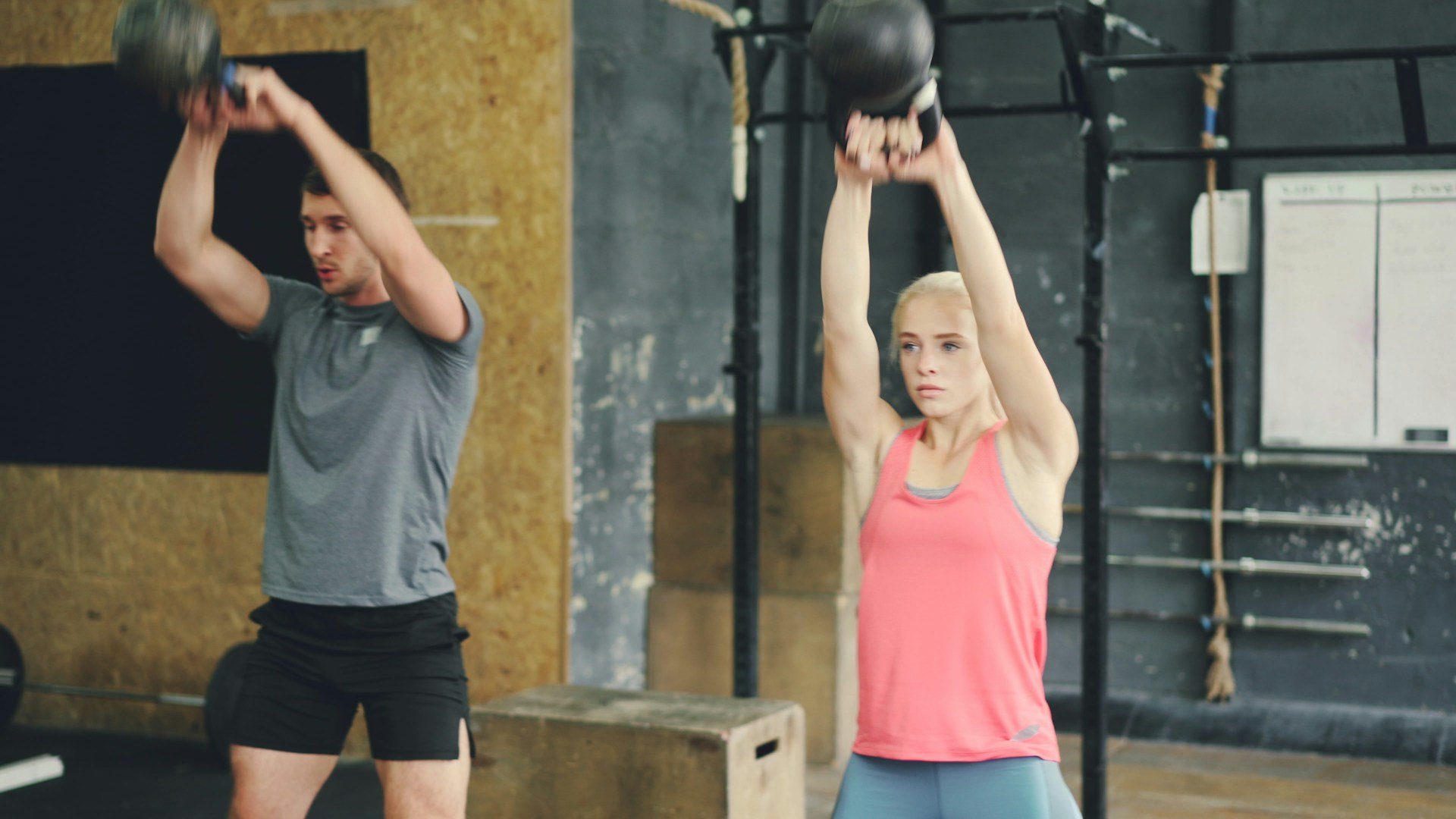
Anyone who has completed several rounds of kettlebell swings already knows the answer. Your heart rate climbs, your breathing gets faster and your cardiovascular system has to work alongside your muscles. Whether a kettlebell workout feels more like strength training or cardio depends on how it is programmed. Heavier weights, fewer repetitions and longer rest periods create more of a strength-focused session. Moderate weights, continuous movements and shorter rest periods create a greater conditioning challenge.
A study involving female collegiate soccer players found that four weeks of high-intensity kettlebell training improved aerobic capacity. The study was small and involved trained athletes, so it cannot predict how everyone will respond, but it supports what many people experience during kettlebell circuits: resistance training and cardio can overlap. Read the study on kettlebells and aerobic capacity. Kettlebells do not need to replace walking, running, cycling or other forms of aerobic exercise. They simply give you another option, especially if you prefer cardio that feels more varied than maintaining one movement at one pace.
Kettlebells Train Your Core Without Endless Crunches
Your core does much more than bend your torso forward. It helps you stay upright, transfer force between your upper and lower body and resist movement when an external weight tries to pull you out of position. Kettlebells are particularly good at creating those moments.
Hold one beside your body and your core must stop you from leaning. Hold it at one shoulder and your body has to resist rotation. Press it overhead and your torso must remain steady underneath it. Swing it and your core braces as force travels from your feet, through your hips and into the kettlebell. Your abdominal muscles are working, but they are working as part of a larger movement. This is useful because life constantly gives us uneven loads. A tote bag hangs from one shoulder. Groceries are rarely packed perfectly. A child shifts their weight while you are holding them.
A randomized study involving 40 adults found that kettlebell training improved the participants’ reactions to sudden disturbances in posture. That does not mean kettlebells guarantee better balance, but it suggests that this form of dynamic resistance training can challenge stability and postural control. Read the research on kettlebells and postural coordination.
Six Kettlebell Exercises Worth Learning
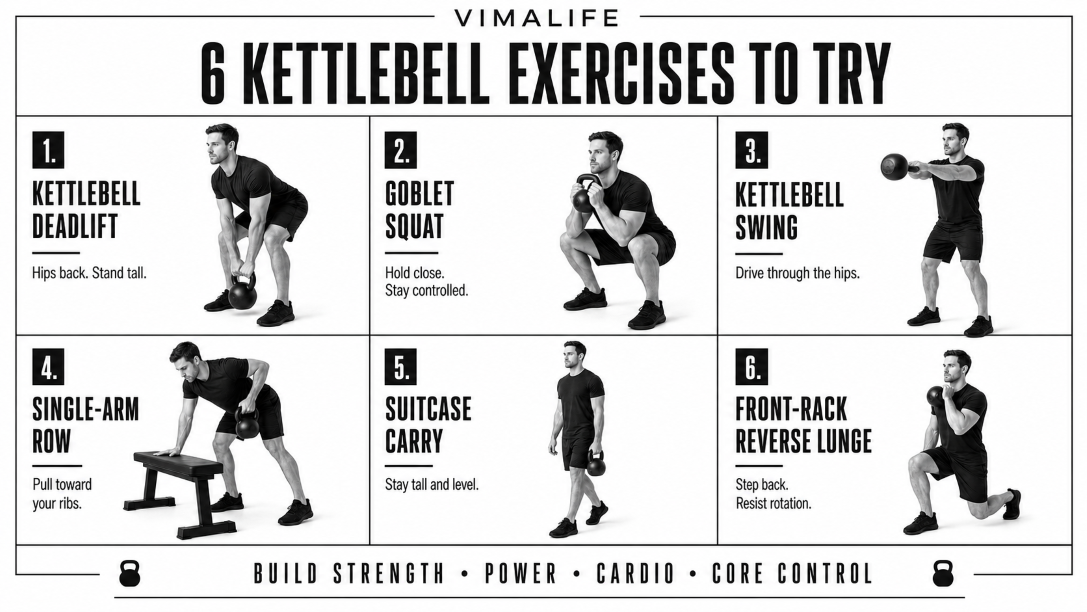
You can find hundreds of kettlebell exercises online. You do not need most of them. These six movements can give you a strong foundation without turning your workout into a performance.
1. Kettlebell deadlift
If you are new to kettlebells, start here. Place the kettlebell between your feet. Push your hips backward, reach for the handle and keep your torso controlled. Drive through your feet and stand tall. The kettlebell deadlift strengthens the glutes, hamstrings, back and grip while teaching the hip hinge used in swings and cleans. It may not look as exciting as a snatch or Turkish get-up, but a strong deadlift is never wasted work.
2. Goblet squat
Hold the kettlebell close to your chest with both hands. Sit down between your hips, keep your feet planted and stand back up. The weight acts as a counterbalance, which can make it easier to find a comfortable squat position. Your legs and glutes do most of the work, while your arms, upper back and core support the kettlebell. Your squat does not need to be extremely deep. A good squat is one you can control.
3. Kettlebell swing
Once your hip hinge is solid, the swing adds speed and power. Hike the kettlebell backward between your legs, drive your hips forward and allow the force from your lower body to send it out in front. You do not need to swing it overhead. Chest height is more than enough when the movement is being powered properly. Start with short sets. Ten controlled swings are more useful than 30 that slowly turn into squats, arm raises and survival.
4. Single-arm row
Support one hand on a bench or use a staggered stance. Keep your torso stable and pull the kettlebell toward your ribs. The row strengthens your back and arms while the single-sided load asks your core to resist rotation. Think about moving your elbow behind you instead of pulling your shoulder toward your ear.
5. Suitcase carry
Pick up one kettlebell and walk. That is the exercise. The challenge is walking normally while the weight tries to pull you off-centre. Keep your shoulders level, your torso tall and your steps controlled. Suitcase carries train your grip, core, shoulders and hips. They also make you appreciate how challenging “just walking” can become when the load is heavy enough.
6. Front-rack reverse lunge
Hold the kettlebell at one shoulder and step backward into a lunge. Your legs perform most of the visible work, but the kettlebell gives your core another job. It must stop your torso from twisting or leaning as you move. If balance is difficult, begin with bodyweight reverse lunges or hold a stable surface. There is no prize for wobbling through every repetition.
A Simple Beginner Kettlebell Workout
You do not need a complicated sequence to get started. Try this full-body kettlebell workout:
Kettlebell deadlift: 3 sets of 8–10 repetitions
Goblet squat: 3 sets of 8 repetitions
Single-arm row: 3 sets of 8 repetitions per side
Front-rack reverse lunge: 2 sets of 6 repetitions per side
Suitcase carry: 3 walks of 20–30 seconds per side
If you already know how to swing safely, finish with five rounds of 10 kettlebell swings. Rest long enough between rounds to keep every repetition sharp. This is not meant to be completed as quickly as possible. Take your time, reset between exercises and choose a weight you can control. A good workout should challenge your body without making every repetition look less coordinated than the one before it.
How Heavy Should Your Kettlebell Be?
There is no universal beginner kettlebell weight. Your starting point depends on your current strength, mobility, training experience and the exercise you are performing. You may comfortably deadlift a kettlebell that would be far too heavy for an overhead press. Choose a weight that feels challenging but manageable. You should be able to finish the set without your posture changing dramatically or the kettlebell pulling you into a position you cannot control. Very light is not always better for swings because it can encourage you to lift the weight with your arms. That is not permission to grab the heaviest kettlebell available and hope your hips figure it out.
This is where coaching helps. A trainer can teach you the movement first and then help you find a weight that makes sense. At VIMALIFE, personal training in Leslieville can help members learn foundational kettlebell exercises, choose appropriate loads and build a program around their individual goals.
Common Kettlebell Mistakes
The most common swing mistake is using the arms instead of the hips. If your shoulders are exhausted but your glutes barely noticed, practice the deadlift and hinge before adding more speed. Another mistake is leaning backward at the top of the swing. The finish should look like a tall standing position, not a backbend. During cleans, the kettlebell should rotate around the wrist rather than crashing onto the forearm. If the bell repeatedly lands heavily, slow the movement down and practise its path with a lighter weight.
Most importantly, do not confuse fatigue with effectiveness. Kettlebells make it easy to create exhausting workouts, but exhaustion is not the only sign of progress. Better control, stronger positioning, a heavier carry and cleaner technique all count too. Biomechanical research has shown that kettlebell movements create specific forces through the hips, back and trunk, which is why exercise selection and technique matter. Read the biomechanical study of kettlebell exercises. If a movement causes pain, do not force it just because somebody online called it functional.
Are Kettlebells Better Than Dumbbells?
They are not better. They are different. Dumbbells are versatile and often feel more predictable because the weight is balanced around the hand. Barbells can usually be loaded more heavily, making them useful for maximal strength. Machines provide additional support and can help target specific muscle groups. Kettlebells are especially useful for swings, cleans, carries and exercises where the offset load is part of the challenge.
Good training does not require choosing one type of equipment and joining its fan club. You might use kettlebells for hip power and carries, barbells for heavier strength work, dumbbells for presses and machines for targeted exercises. The better question is not, “Which one is best?” It is, “Which one makes sense for what I am trying to train?”
Why Kettlebells Make Training More Interesting
There is something satisfying about learning to use a kettlebell well. At first, the weight feels awkward. Then your hinge becomes sharper. Your carry feels steadier. Your swing starts to feel powerful instead of chaotic. You are not simply adding weight. You are learning a skill. That can make strength training feel more engaging, especially if you lose interest when every workout follows the same pattern.
Kettlebells also allow you to move between exercises without changing equipment. You can lift the kettlebell from the floor, squat with it, row it and finish with a carry. The workout begins to flow. That does not mean kettlebells need to replace everything else in your routine. They can work alongside barbells, dumbbells, machines, walking, running, Pilates, yoga and mobility training. At VIMALIFE, kettlebells are part of a more complete approach to movement. Members can train independently on the open gym and functional strength floor, work with a personal trainer or join fitness classes in Leslieville across strength, HIIT and conditioning.
There is also space for Pilates, yoga, barre, mobility and recovery because fitness works better when the pieces support one another. Strength helps you produce force. Cardio helps you sustain effort. Mobility helps you move through useful positions. Recovery gives your body time to adapt. Kettlebells happen to train several of those qualities at once.

The Kettlebell Is Simple. That Is Its Strength.
A kettlebell gives you a weight and a handle. The rest is up to you. You can lift it, swing it, carry it and learn to control it. You can use it to build strength, power, conditioning, stability and confidence without needing an entire room of equipment. If you have been walking past the kettlebell rack because you were unsure where to begin, start with a deadlift. Learn the hip hinge. Try a goblet squat. Pick up one kettlebell and carry it across the room.
You do not need to master every exercise in one day. But once you understand what a kettlebell can do, you may never look at that little cannonball with a handle the same way again. VIMALIFE is a boutique fitness club in Leslieville, Toronto, offering open gym access, personal training and 200+ monthly classes across strength, HIIT, conditioning, Pilates, yoga, barre and recovery. If you are looking for a gym in Leslieville, functional strength training in Toronto, kettlebell training or personal training in Leslieville, book a complimentary VIMALIFE Guest Pass and experience the club for yourself.