
Progressive Overload Explained: How to Keep Getting Stronger
At some point, the dumbbells that once felt heavy become the pair you reach for without thinking. Ten reps used to take some concentration. Now you finish the set knowing you probably had a few more in you. That change can be easy to miss because nothing dramatic happened. The workout just started to feel more manageable. But that is your body adapting. What challenged you a few weeks ago has become familiar, which means it may be time to ask a little more of it.
This is progressive overload: gradually increasing the challenge as you become stronger. Sometimes that means lifting more weight. Other times, it is one more repetition or an extra set when it makes sense.
Despite the name, progressive overload is not about making every workout harder or leaving the gym exhausted. It is a way of making sure your training continues to challenge you bit by bit as your strength improves.

Progress does not have to happen every workout
There is a restless version of progressive overload circulating online: more weight every week, another personal best, no backward steps. Real training is less tidy. Some exercises move quickly while others stall. A poor night of sleep can make last week's weight feel unexpectedly heavy. Smaller muscles often progress in smaller jumps, and the next available dumbbell may be too large an increase. None of this means the programme has stopped working.
The American College of Sports Medicine's updated resistance-training guidance places consistency ahead of complexity. Training the major muscle groups regularly matters more than building an elaborate system of weekly increases. Progressive overload gives those repeated sessions a direction, but it still has to leave room for recovery and ordinary life.
Sometimes the right decision is another workout at the same weight. The question is not, “Did I add something today?” It is, “Is this exercise still asking enough of me?”
More weight is only one option
Load is easy to measure, which is probably why it receives most of the attention. A 25-pound dumbbell is clearly heavier than a 20-pound one. Yet the body also notices when the same load is lifted for more repetitions or across more total work.
In an eight-week resistance-training study published in PeerJ, experienced lifters progressed lower-body exercises either by adding weight or by adding repetitions. Both groups gained strength, and muscle growth was broadly similar across most of the areas measured. It was one study over a relatively short period, not proof that the two approaches are interchangeable forever. It does show that adding a rep can be real progress, not a consolation prize while you wait for the next dumbbell.
Progress can also come from improving the exercise itself. A deeper squat completed with control, a push-up from a lower incline or a row that no longer needs momentum may be more meaningful than a heavier number attached to a poorer movement.
Other variables matter too: sets, range of motion, exercise difficulty and weekly training frequency can all change the demand. Adjust them deliberately. If weight, repetitions, sets and exercise complexity all rise together, it becomes difficult to know what caused the workout to unravel.
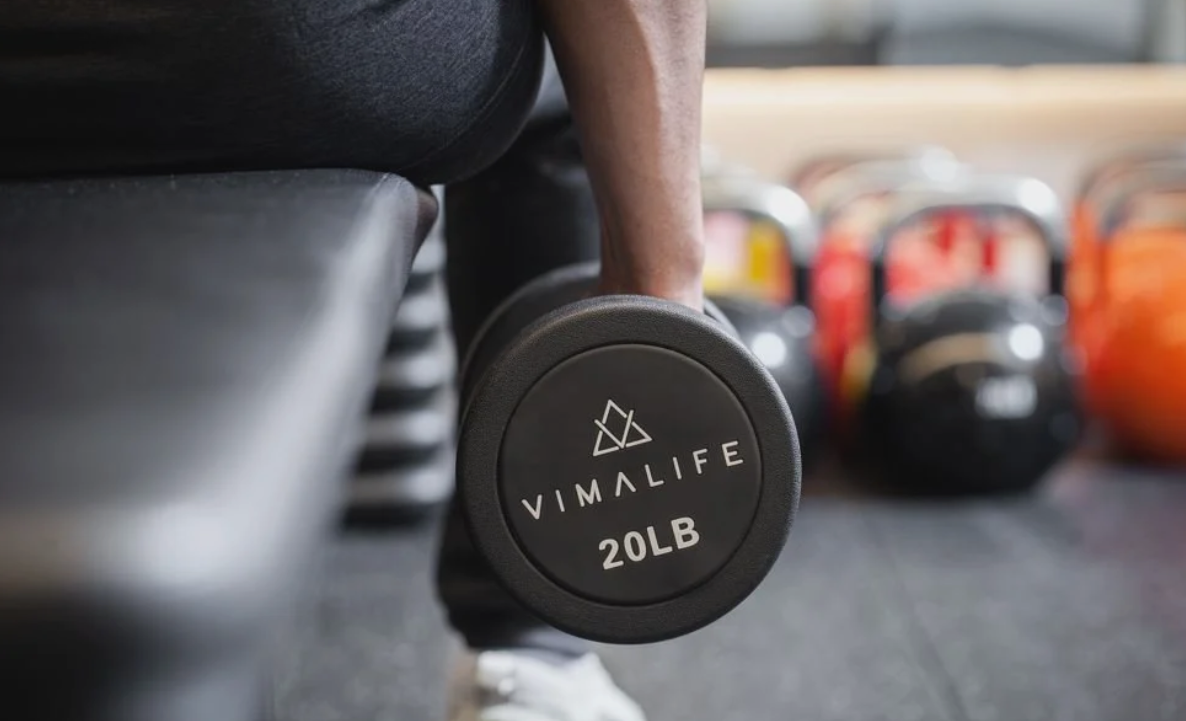
A practical way to progress: build the reps, then the weight
Consider a dumbbell row programmed for three sets of eight to twelve repetitions. Choose a weight that makes the end of each set feel demanding while leaving perhaps two good repetitions available.
Your first session might look like this:
25 lb × 8
25 lb × 8
25 lb × 8
Over the next few workouts, the entries may become 10, 9 and 8, then 11, 10 and 9. Progress rarely arrives in three matching columns.
Once you can perform all three sets near the top of the range with the same control and a similar level of effort across more than one workout, try the next sensible weight. The repetition count will probably fall towards eight again. From there, you build back up.
This is often called double progression: first increase repetitions within a range, then increase the load. It is simple enough to use without turning every workout into an accounting exercise.
Keep the jump reasonable. If moving to the next dumbbell turns a row into a full-body swing, the new number is not telling the whole story. Stay with the previous weight, use smaller plates if available or choose another version of the exercise that can be adjusted more gradually.
How hard should a set feel?
Repetition targets are useful, but they can become strangely persuasive. People stop at ten because the programme says ten, even when the set has barely begun to feel like work. Others assume a set only counts if the final repetition ends in total failure.
Most training can live somewhere between those extremes.
A practical starting point is to finish many working sets with roughly two good repetitions left. Coaches often call this “two reps in reserve.” The estimate will not be perfect, especially when you are new to strength training, but accuracy improves as you learn the difference between discomfort, slowing and true muscular failure.
You do not need to empty the tank every time. In a 2024 study of resistance-trained adults, stopping sets with one or two repetitions in reserve produced similar quadriceps growth to training until another repetition could not be completed, while failure training created more immediate fatigue. It was a small, eight-week study, so its value is practical rather than absolute: productive work can still leave something behind.
There are times when a coach may deliberately use sets closer to failure. That is different from accidentally turning every exercise into a test.
Rest is part of the programme
Shorten your rest periods and a familiar weight can feel brutally heavy. It is tempting to read that feeling as progress. Often, it simply means you started the next set before you had recovered enough to perform it well.
In a small study comparing one-minute and three-minute rest periods, trained men who rested longer made greater strength gains over eight weeks. Short rests can suit circuit and conditioning work, where sustained effort is part of the point. For strength, give yourself enough time to reproduce a strong, controlled set.
This matters when tracking overload. If last week's squats included two minutes of rest and today's included 45 seconds, the numbers are not directly comparable. The workout changed even if the weight did not.

Keep a record simple enough to use
You do not need a colour-coded spreadsheet. Write down the exercise, weight and repetitions completed in each set. Add a brief effort note when it helps.
“30 lb: 10, 9, 8; about two reps left” gives next week's version of you something useful. “Great workout” does not.
Try to keep the conditions reasonably similar when you compare sessions: the same exercise variation, a comparable range of motion and roughly the same rest. No two workouts will be identical, but a little consistency makes the pattern easier to see.
A training log is also reassuring on the days that feel unremarkable. Progress becomes visible across weeks even when no single session felt heroic.
When progress seems to stop
One difficult workout is weather, not climate.
Several weeks of unchanged or declining performance deserve a closer look.
First, check the ordinary things. Have you been training regularly? Are you rushing your rests? Has sleep been poor? Did other workouts, work or stress quietly increase the total load on your week? The answer is not always another set.
If you feel well recovered and the exercise has become easy, add a small amount of challenge. If you are consistently worn down, repeat a manageable workload or temporarily do less. A short easier period can restore momentum more effectively than pushing harder into fatigue.
Technique matters here too. An exercise may need a smaller increment, a different setup or simply more practice. Pain that changes the way you move is not a progression problem to solve by force; stop and seek appropriate guidance.
Progressive overload in a class
Class programmes do not always repeat the exact same workout, which makes progression less obvious, but not impossible.
At VIMALIFE in Leslieville, VIMAFIT strength and conditioning classes use coached resistance exercises in formats such as Pure Strength and VIMAFORCE. When a familiar movement returns, remember what you used last time. If the repetitions, tempo and purpose are comparable, ask the instructor whether the next weight makes sense.
Not every class is designed for maximum strength. On a faster conditioning day, maintaining good movement with the same load may be the more useful choice. Progress should match the assignment.
If you want programming built around your own history, schedule and goals, personal training at VIMALIFE offers more room to follow those changes closely. A coach can be particularly useful in the awkward middle ground between a weight you have outgrown and one you are not quite ready to control.
For the next workout, bring the numbers from the last one. Perhaps you are ready for another repetition. Perhaps the same weight needs one more honest session. Either answer is better than adding difficulty simply because the calendar moved forward.
You can explore the gym floor, try a class or combine both with a complimentary VIMALIFE Guest Pass Experience.
Frequently Asked Questions
What is progressive overload?
Progressive overload is the gradual increase of training demand as your body adapts. In strength training, this often means adding weight or repetitions, though sets, exercise difficulty, range of motion and training frequency can also change the challenge.
When should I increase the weight?
Consider a small increase when you can reach the top of your planned repetition range with controlled technique and the set no longer feels sufficiently challenging. Repeating that performance across more than one workout can help confirm that you are ready.
Can I use more repetitions instead of heavier weight?
Yes. Adding repetitions within a sensible range can provide progressive overload. Once you consistently reach the top of that range, increasing the load can keep the exercise from becoming an endurance set that no longer matches your goal.
Do I need progressive overload every workout?
No. Progress is judged across time, not by forcing an increase in every session. Recovery, technique and the size of available weight jumps all affect when progression makes sense.
Does progressive overload mean training to failure?
No. Sets can stimulate strength and muscle growth without ending at complete muscular failure. Many people can train effectively while finishing working sets with one to three good repetitions still available.