
There is a familiar moment at the dumbbell rack: the weight you used last week feels manageable, but the next pair looks like a sizeable jump. Should you pick it up, or stay where you are and do more repetitions? The answer depends partly on what you want from the exercise. If your priority is improving the heaviest weight you can lift, heavier training usually has an advantage. If your priority is building muscle, a wider range of weights and repetitions can work, provided the sets are sufficiently demanding.
That leaves room for preference, experience and practicality. A productive routine can include a heavier leg press, a moderate-repetition row and lighter lateral raises. You do not need to choose one style and apply it to everything. The place to start is with what “heavy” means for you.
Heavy is relative to the person and the exercise
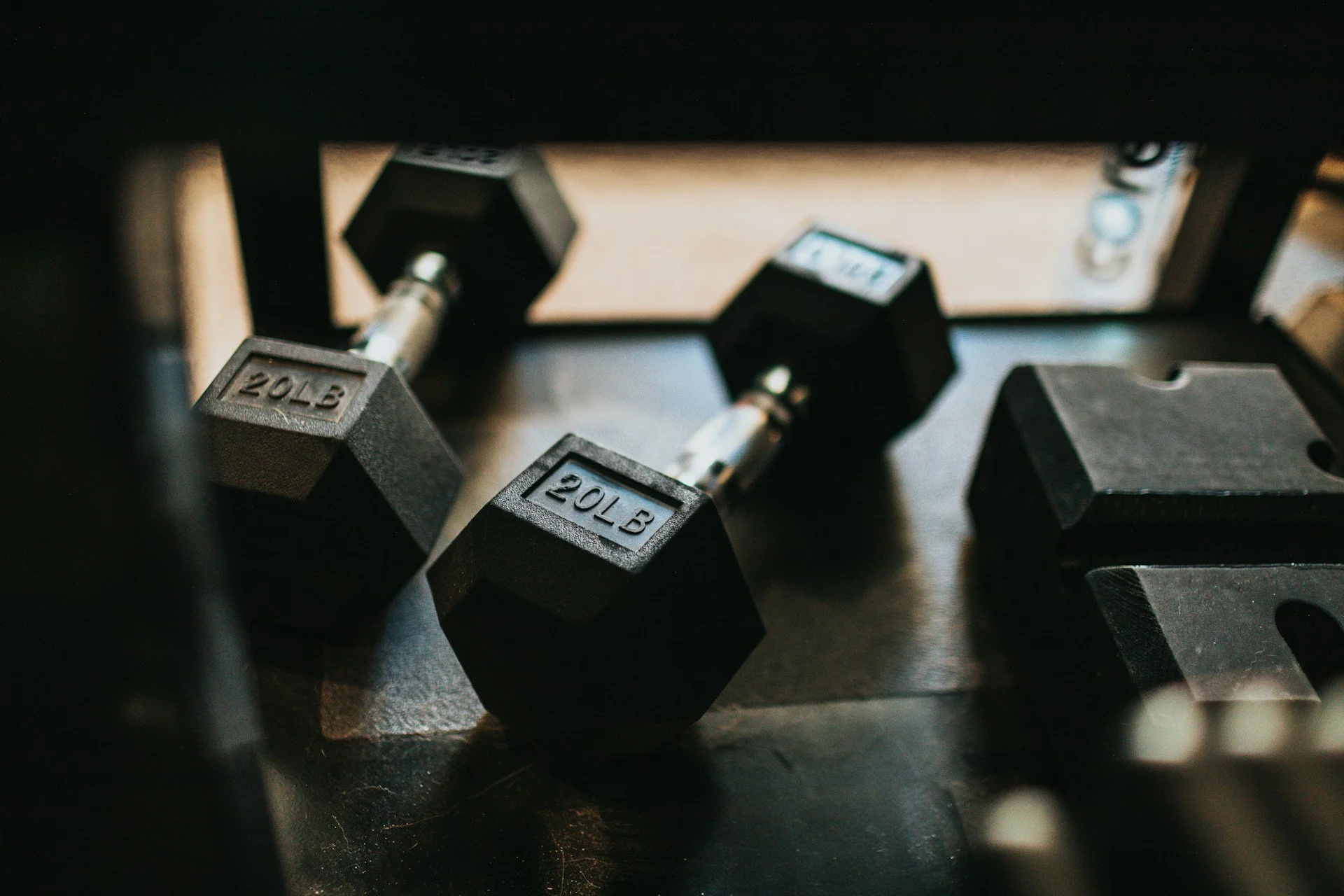
A twenty-pound dumbbell tells you the load. It tells you very little about the effort. For one person, it may be a demanding curl. For another, it may be a comfortable goblet squat. Even within the same workout, different exercises require different weights.
Researchers often describe loads as a percentage of a one-repetition maximum, or 1RM: the most someone can lift once in a particular exercise under the test conditions. A load around 80% of that maximum is relatively heavy. A load around 40% is lighter, even though enough repetitions can make it challenging.
You do not need to test your maximum to choose useful training weights. A target repetition range and an estimate of how many more good repetitions you could perform are often more practical. Repetition ranges also overlap. Six repetitions might be easy with one weight and close to your limit with another. The number matters alongside the effort required to reach it.
If you want to lift heavier, practise lifting heavier
A 2023 systematic review and network meta-analysis compared combinations of training loads, sets and weekly frequency. Its strength analysis included 178 studies and 5,097 participants.
All the resistance-training prescriptions improved strength compared with no exercise. Programmes using heavier loads, above 80% of 1RM in that analysis, generally produced the greatest strength gains. Part of the explanation is specificity: improving a heavy lift involves practising the skill of producing force against a heavy load. The setup, coordination and confidence required are part of that task.
A separate review of 21 studies comparing lower and higher loads reached a similar conclusion for one-repetition maximum strength. Higher loads produced greater gains on that test. Differences were not significant for isometric strength, measured without movement, showing that the test itself influences the result.
This gives heavier work a clear purpose. It does not mean a beginner needs near-maximum attempts. You can learn an exercise with manageable resistance, gradually build confidence and introduce more demanding weights as the movement becomes familiar.

Muscle growth gives you more options
The same 21-study review found similar average muscle-growth outcomes with lower and higher loads. A crucial detail: the included programmes took sets to muscular failure, the point where another repetition could not be completed. That makes the finding more specific than “light weights work just as well.” The lighter sets involved substantial effort.
A twelve-week trial at McMaster University makes this easier to picture. Forty-nine young men with resistance-training experience used either lighter loads for roughly 20–25 repetitions or heavier loads for roughly 8–12, taking sets to volitional failure.
Both groups increased lean body mass and the size of the muscle fibres measured, without significant differences between groups. Both also improved strength. The heavier group gained more bench-press strength, while differences on the other strength tests were not significant. The study supports having options for growth, although its participants and twelve-week duration limit how broadly we can apply the findings. It also shows why the question needs a goal attached: similar muscle growth can coexist with differences in a particular strength test.
A lighter weight can still mean a very hard set
Higher-repetition training often looks approachable at the beginning. The first ten repetitions move easily. The next five require attention. By twenty, the muscles may be working hard enough that continuing feels distinctly unappealing. That experience matters when choosing a programme. Some people prefer the shorter concentration required by a heavier set. Others feel more comfortable with a lighter load and a longer set. Neither preference is a character trait or a measure of commitment.
For muscle growth, effort appears to be an important part of the picture. A 2024 analysis of proximity to failure found that muscle growth tended to increase when sets ended closer to failure. Strength gains showed a much weaker relationship. The researchers estimated how many repetitions remained from study descriptions, so the analysis could not identify an exact ideal stopping point.
In practice, ask yourself: “Could I do two or three more repetitions with the same technique, or another fifteen?” Those are different sets even if both end at twelve.
Do you have to keep going until you fail?
You can train hard without making every set an absolute limit test.
A systematic review of fifteen studies found no significant overall difference in strength or muscle growth between failure and non-failure training. A subgroup analysis suggested a small muscle-growth advantage for failure in trained participants, but all the included studies involved young adults and the evidence had important limitations. Taken alongside the proximity-to-failure research, the useful interpretation is that challenging sets matter, while complete failure is not a universal requirement.
Leaving roughly one to three good repetitions available can be a practical starting point for many muscle-building sets. Treat that as a coaching guide rather than a precise threshold established for everyone. Beginners may need a larger margin while learning, and very light loads may need to be taken closer to their limit to provide a comparable challenge.
Stop if maintaining the exercise requires a substantial change in technique. Also notice what is ending the set. Losing your grip, becoming breathless or feeling joint pain gives different information from the working muscles reaching their limit.
Choose a range you can use well
For someone building a general strength routine, moderate repetition ranges are often convenient. Sets of approximately eight to twelve give enough practice to learn a movement without requiring either very heavy loads or unusually long sets.
As experience grows, you can choose ranges more deliberately:
For practising heavier strength work: around four to six repetitions can be useful on a familiar exercise, with an appropriate load, setup and recovery between sets.
For much of your muscle-building work: roughly eight to fifteen is a practical range to organise and progress.
For selected smaller exercises or lighter equipment: fifteen to twenty repetitions, or sometimes more, can also be productive when the effort is appropriate.
These are examples, not biological borders. Muscle does not stop responding when you cross from repetition twelve to thirteen. The best range also depends on whether the exercise remains comfortable and controllable as the set continues. Someone might enjoy eight repetitions on a seated row and prefer fifteen on a lateral raise. Those choices can coexist within the same sensible programme.
When should you add weight?
Return to the dumbbell rack. Suppose your plan calls for two sets of eight to twelve repetitions, finishing with a couple of good repetitions still available.
At first, you manage nine and eight. Over the next sessions, those become eleven and ten, then twelve and twelve at a similar effort. That is a reasonable moment to try the smallest available weight increase. Your repetitions may drop towards eight again, and you build from there. This approach gives both repetitions and load a role in progression. You are looking for repeatable improvement under similar conditions, rather than adding weight simply because another week has passed.
If the next dumbbell is too large a jump, stay with the current weight while improving repetitions, or ask a coach about another suitable option. Keep your range of motion, rest periods and technique reasonably consistent when judging progress.
The ACSM's 2026 position stand supports progressive resistance training across a broad range of workable prescriptions. Your programme should give you a way to advance as your capacity changes.
Build a routine around the work you can repeat
Choose heavier work where it serves a strength goal. Use moderate or higher repetitions where they suit the exercise and make training more manageable. Pay attention to effort, and give yourself time to learn how different sets feel.
If you are unsure which weight to start with, a VIMALIFE personal trainer can help you practise the movements and organise progression around your goals.
To explore the club and find a comfortable starting point, book a complimentary VIMALIFE guest-pass experience.